
Abstract
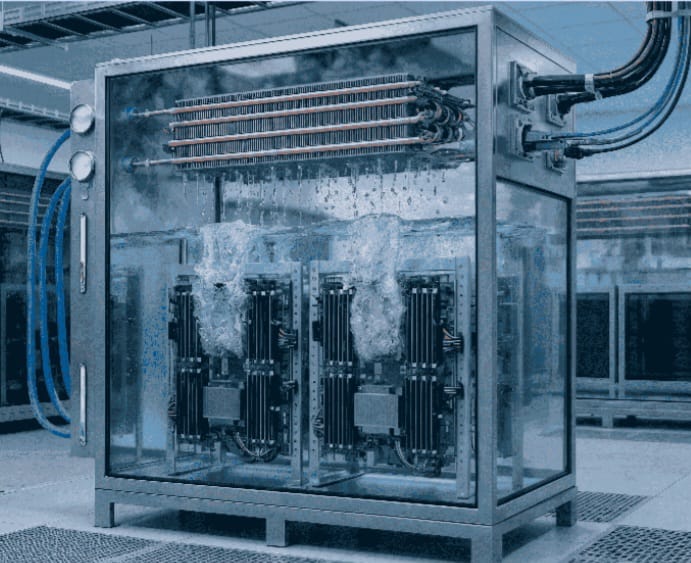
The scalability of Artificial Intelligence (AI) faces a practical-physical limit under conventional cooling paradigms. This study examines the transition to two-phase immersion cooling as a necessary—though not the only theoretically possible—solution for managing the thermal density of next-generation semiconductors.
Through an analysis grounded in exergy thermodynamics, boundary layer fluid mechanics, and Landauer's Principle as a conceptual framework, it is demonstrated that nucleate boiling enables heat flux management exceeding 500 W/cm² under practically achievable conditions. Results obtained through first-principles-based theoretical analysis, complemented with experimentally validated correlations, indicate that Power Usage Effectiveness (PUE) can be reduced under optimal conditions to values on the order of 1.03-1.04 (theoretical range, implementation-dependent). Furthermore, a substantial improvement in hardware reliability is estimated, quantified by an acceleration factor (AF) of approximately 16.5× according to Arrhenius's Law.